
A door, three times. One painting (p11), two drawings (p11, p23). Twice carried on the back of a man or a woman. Once, alone, in space.
A door, a plane (flatness), like a page. A plane upon a plane, on the plane of a back.
A door is a force against (Go Away, Step Back), a barrier, closed. Or open, an entrance, guard down; but then again: who knocked, why. Perhaps keep it closed.
Don’t lose your door; it’s dangerous to lose your door.
Shut the door. Too late. And this door (p23), the same door as the one on the back, has already had an edge taken, where the hinges were.
From above, a door facing-up slowly moving across the land (as seen from a ‘plane’ carrying bombs), on its way to somewhere safe, is a target. A door, in case a home is found. A door to start a home with, to try again to keep the enemy at bay.
(Pages, painted on a woven cotton canvas stretched over a wooden frame – already a sculpture – just needs a tiny stitched red cross in the middle and ‘presto’, it’s done. Must tell the artist.)
The cover of a book is a door, we open a book, we enter. The book is titled Ghostly Pages. There we have it; detours and delays, time suspended, never to begin again; writing, therefore, is too much. Detours/delays give us time. They are gifts/offerings so we remember, so images arise – a whole book of images, of points and lines (without lines, p5, p9, p10) and depths/caves/holes and atmospheres.
There was the other body-of-work titled The Book of Questions at Adelaide Central Gallery in 2024. Twenty black and white paintings, and several wax sculptures on the floor; the images referenced the posters pasted on walls in Naples announcing a death and burial details. Now there’s Ghostly Pages (another book), thirteen paintings, nineteen drawings. (I mostly mention the paintings, although I refer to ‘works’, and six drawings are drawings of six paintings.) In the olden days, 2015, I wrote a little text titled ‘and’ (for Aldo’s exhibition, Pulp, at Fontanelle) where I said (I thought) Aldo’s paintings were writerly (soon, in the text, I changed the word to ‘writingly’). I wrote cautiously, saying I was probably taking a step too far; saying I was being unfair, ‘and’ I wrapped-up the text and slipped it inside a brick made by Aldo that then sat on a table with other clay objects. I entombed/disappeared the text. (It was also available as an A4 handout, picked-up by few visitors.) I was wrong about my ‘writingly’ allusion, or wrong to bring it up as a ‘painterly’ concern, or so I worried at the time and afterwards, even knowing Aldo’s paintings often relate to reading. (I wasn’t wrong or right; I was heading out (too soon), towards these two bodies of work.)
There’s something like a ‘potion’ that forms in an artist’s work over a long time, and surfaces in various ways in what are new and distinct works, in Aldo’s case ‘series’ or ‘bodies’ or ‘intensities’ – in Ghostly Pages, are all three at once, pressed, spread, pushed, fading, arriving: a series of pages (ghosts); a body of work, of different affects; a field of intensities that reaches into the past and the future.
Each painting is a focussed image of a complex sensitivity or disturbance that unfolds in thought/imagination to shelter, like a fine veil, an immense situation or action, that has happened or is in the throes of happening (small acts may help: the butterfly effect, ripples to slightly change the world; kindness, protesting, listening, thanking, asking)).
WCNSF. There it is, bare, p13. Wounded Child, No Surviving Family. Five letters, words, of disaster, of war. We should know these letters by heart. The acronym is unique to the Gaza Strip; as of February 2025, the United Nations reported there were 25,000 wounded children with no remaining relatives.
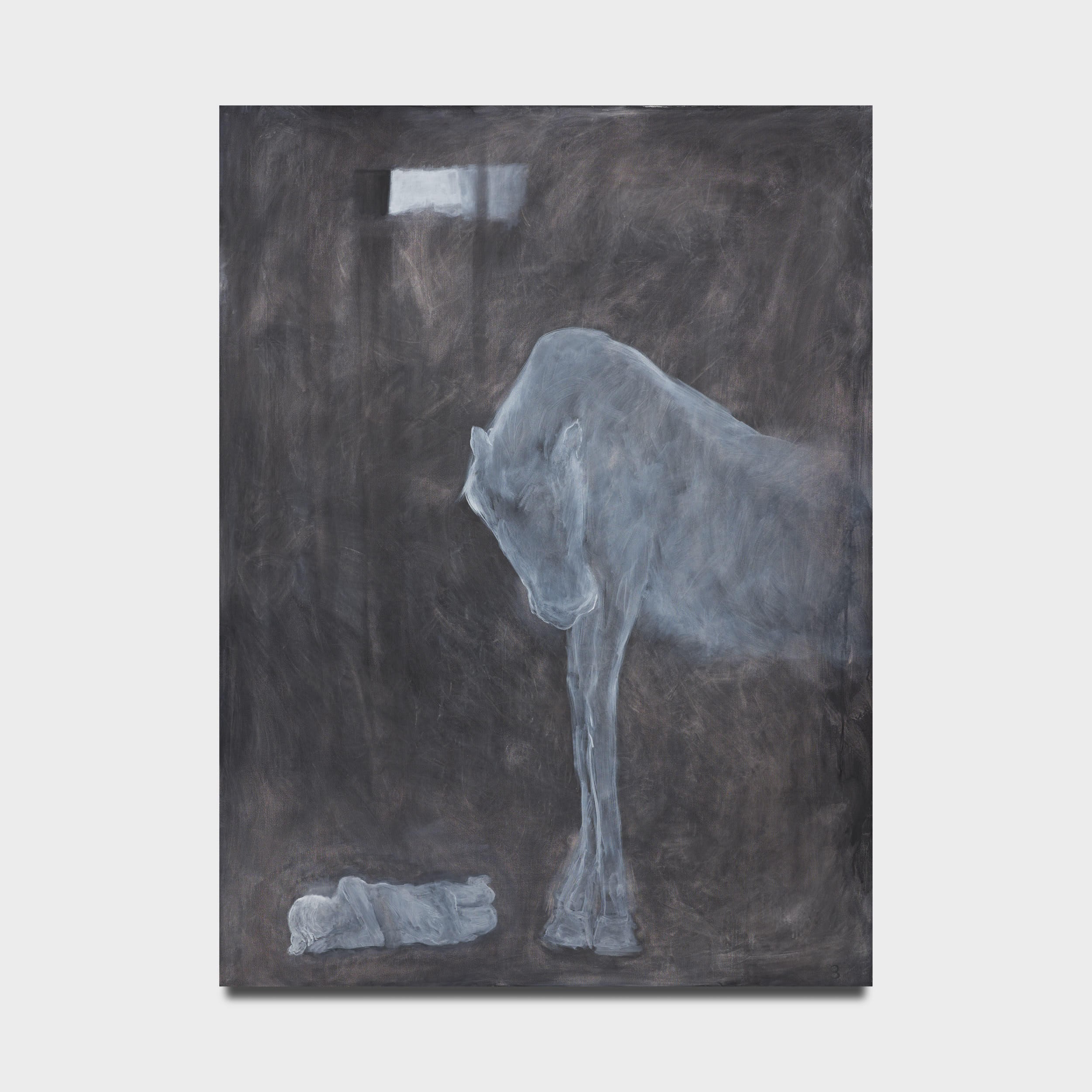
And there’s a child, curled-up, sleeping, watched over by a horse, p3. Dreaming, safe for awhile. A memory of a story told to Aldo by his mother. The persistence of the precise memory passed on, now passed on again, in paint.
A book of infinity; an infinite book, each page a book – in the face of a world in dis-array, thrown into the air, blasted, floating in the universe just as the fragments of clothing/cloth on p5, with a little flower lasting on the ground. All of us shoved into a cart, heads in the sawdust, legs and feet, bits, tangled, severed perhaps, to show we were/are here, here we are, nothing left to say, to scream about. Except what we want to say, a book for us to talk/scream about. What might ‘I’ be to these pages. We can’t even take those wheels for granted, they will fall off under the weight of our (dispensable) limbs and organs.
Holding with care forces of different degrees, that come to and through us as memories or concerns or anguish, takes practise; not grasping and squeezing them, but admitting them, granting them space to expand, unwind their fury or sadness, and rest, before they (as force renewed) gather their ‘insides’ and transform. That is, then, that they can be(come) visible, be(come) an image, painted.
The battle to the death that happened in the web has been won and lost. The web, still beautiful, holds fast; nevertheless a war-ground, an arena within which to die.
Force causes a sensation in the body and mind. A story told or overheard or read sets off wave-motions (like wings do), transferring energy, of pain, empathy, fear, or remembrance. Oh, there’s a witch’s hat. I know what that is. Or is it a moveable magic mountain or a dunce’s hat or a cone-of-silence. There are two tiny people carrying their suitcases into the cone. There’s no-one else around. They’re at the mercy of forces bearing down and around them, not least gravity, graveness even. What they feel, I imagine, is not the forces themselves, but the energy released inside their bodies – chemicals, heat, shivers, tears, as if hit by bolts of lightning. We see an ‘invisibility’ as ‘visible’ in the painting; a painting of what cannot be seen.
The butterfly can be seen, clearly, dead or alive, at the bottom of the canvas, on the soft grey background, below the words: WE ARE BUTTERFLIES … but ‘I’ can’t be seen as a butterfly; can’t see their tiny perturbations either (or even the flight mechanism, the clapping of their wings that creates small air pockets). I don’t have wings, or so it seems. They are folded against my back. Yes, really, I’m a butterfly, it’s true. And so ‘I’ undoes who I am; no identity, NO. Given away, gladly. I’m the child too, and the horse, and all the people tied down with (lead) balls and the brick wall and the person carrying the door, and the door, and the … This is not about ‘I’ AT ALL.
I remember Aldo’s drawing of a man exploding; streams of ‘water’ spurt out from his stomach. That’s also something he was told long ago and still carries – an internal force. A drawing of time, of someone, of a question: what is wrong with my uncle. How much does time weigh – upon thinking.
The backgrounds are not nothing. They are everything, they contain all that ever was/is (the stars, atoms); from them, from the abyss, we make ourselves – our beliefs, knowledges, joys, anger; the backgrounds are the substances, the always-present in all its material languages, voices, colours, and subtle forms; there are breaks and threads, like on p2; there’s a window on p3; there are soft lines and swirls on p4: and p6 is just immense … and on p9, see that little crack in the upper left, underscored by black … small indication of complications, impediments, and exquisite potentials.
It’s not a wall (p4), it’s the sense of a wall, it’s being-built (this sense), its purpose is stoppage (no doors in sight). We are this side or that. We are on this side, but what and whose side is ‘this side’; is ‘that’ side the ‘other’ side or is ‘this’ side the ‘other’ side. We’re trapped, either way. It’s a sign – a big immobile ever-higher man-made solidity to bash our life against. But, out from the wall, on both sides, shelters could be built (let’s pretend), it’s a matter of despair, imperative. Too much to expect. Paint on it, do something. It’s frightening, we’ve visited these walls. The wall is a force of commands, orders, mandates, fears, dug into the sacred ground, a giant seed of medicine/poison. Eat it. Eat (AT) ALL of it.
It’s not his or her door, it’s a door, it’s the weight of the door. It’s the carrying of the weight of the door – that’s the painting; and fingers hanging on for dear life.
What we are given (as a painting) is right before us, as it is, as it might have once been seen, and is, still. Mass stilled, seen in its passing. Ghostly, as ghosts, as circumstantial ghosts, one by one. The ‘I’ is circumstantial too (the ‘I’ is a ghost), as it approaches these pages, this book, this way of writing into the world, the world being abstract, stirred-up, surface upon surface. Violence is very quiet; violence is the relationship between the image ‘I’ sees and the background ‘I’ sees (and the force ‘I’ can’t see). This between is infinitesimal (and holds apart the parts), the image and the background are one and not-one, an indeterminate space (like force, invisible, yet absolutely real) where anything can happen. Hand on face for instance. Air on eye. Who or what force has knocked at the door, knuckle on wood. The door is all that’s left: take it to the wall, lean it on the wall.
There are no spectacles here. Even the battle in the web has vanished. The wall is bare, new, ready for more bricks (and ready to fall). The hooks await, the cart is overflowing and unattended, the light and dark clouds keep each other company, the butterfly is beautiful, the witch’s hat heavy.
And the hands, ghostly obviously. A haunting of sorts, an archive even, caught in the light, pictured, transparent, x-rayed. No escaping their shape, their age too. Ghost hands (that paint), already older. I believe in ghosts and in hands. Reading always, ghosts. Seeing paintings, ghosts, as written, images thought in the past, near and far, present now, present tomorrow; ghostly future time. The ‘I’, I am, is a composition of ghosts, an apparition.
Ghostly Pages p1 is an image, a painted picture, a cover for the twelve other paintings/pages; it’s charged with ONE (1), marked to be first. It’s troubling because it’s not a ‘cover’, it stands up by/for itself. It’s haunted by all other ‘covers’ that keep and have-kept pages together, hidden, protected; the cover covers all writing, all fiction/poetry, all convolutions of thought through time. It weighs with white, and its force/mass is declaratory. This is … THE COVER, and it tells what the other paintings are: pages, and they are ghost(s)/ly, and ghosted.
The images (are) appearing as if re-appearing (never seen before yet after-images of after-images, and all invisibly visible inside us, for safekeeping), wanting to be seen, shared, without rules or laws (of how they should be seen), and caught (fleetingly) as they envelop and adjust us – gracious wilful spectres dissipating; the fragile and fantastic mourning of one’s being-with-death, one’s being-with-life.
– Linda Marie Walker
February 2026